In the present world, the established order is capitalism. So, whatever is called globally mainstream is connected with this order. If in a country, a non-capitalist system such as socialism can be established. Then their mainstream will be socialism.
Introduction: In the
bustling streets of India, amidst the vibrant tapestry of cultures and
livelihoods, a resounding call for justice echoes. The Farmers' Protest in
India in 2024 has gripped the nation, underscoring the struggle of the agrarian
backbone against systemic inequities. As tractors and trucks line the roads
leading to New Delhi, the demands of the protestors reverberate, challenging
the status quo and igniting conversations on socio-economic justice.
Context and Background: The genesis of the Farmers' Protest in India traces back to the
passage of contentious agricultural laws by the Modi government. These laws,
purportedly aimed at reforming the agricultural sector in a neoliberal line,
faced staunch opposition from farmers who perceived them as threats to their
livelihoods. As media reported,
the laws allowed for direct selling to bulk buyers and eased contract farming,
triggering concerns about exploitation and market dominance. Despite assurances
from the government, demonstrators remained apprehensive, fearing the erosion
of their rights.
The central government had to withdraw the
Farmers’ Produce Trade and Commerce (Promotion and Facilitation) Act, The
Farmers (Empowerment and Protection) Agreement of Price Assurance and Farm
Services Act, and The Essential Commodities (Amendment) Act after the 2021
Farmers’ protests.
Demands and Grievances: At the heart of the protests lie multifaceted demands reflecting the
myriad challenges faced by the agrarian community. The rallying cry for a
Minimum Support Price (MSP), as highlighted by the media, underscores the
urgent need for economic security amidst volatile market conditions. Farmers
seek not only financial safeguards but also debt waivers, compensation for
deceased comrades, and assurances against the privatization of essential
services like electricity. These demands, emblematic of broader structural
issues, underscore the systemic neglect faced by farmers for decades.
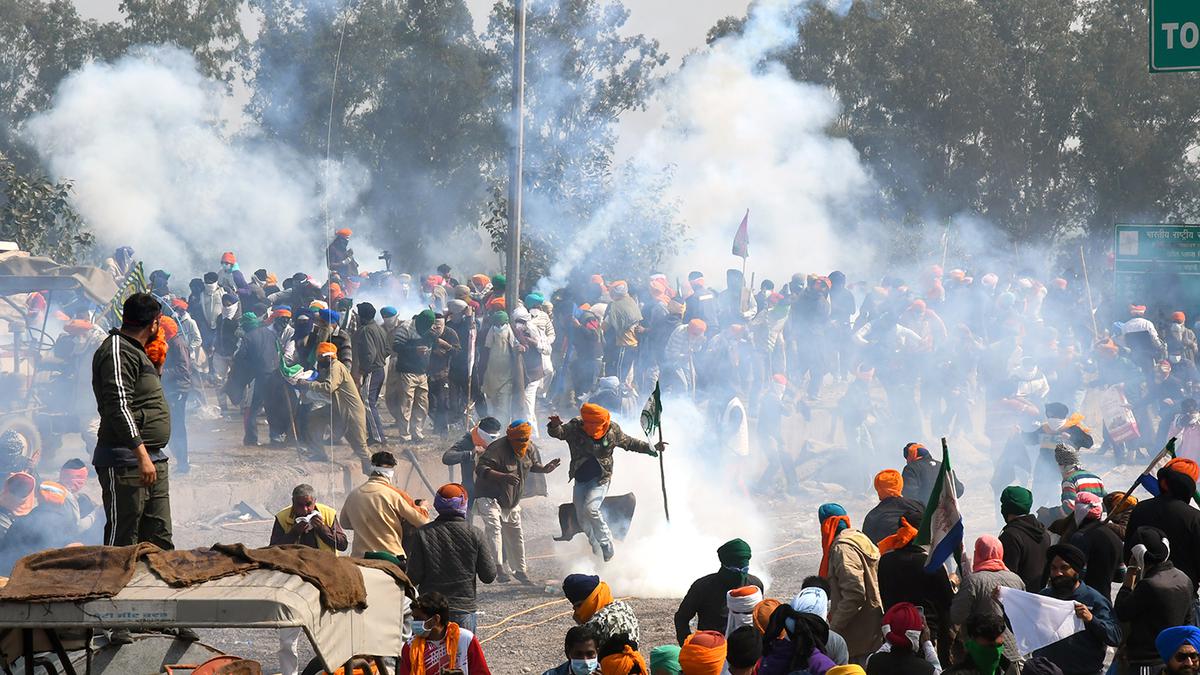
Government Response and Policies: In response to the protests, the Modi government unleashed a
formidable crackdown, as documented by media reports.
Tear gas, barricades, and internet suspensions became tools of suppression,
reflecting a government determined to suppress dissent. Despite sporadic
negotiations, trust eroded, with farmers decrying broken promises and
government apathy. The standoff underscores a deeper ideological chasm, pitting
agrarian livelihoods against corporate interests, with ramifications for
India's socio-political landscape.
Protest Dynamics and Impact: The current Demonstration in India unfolds against a backdrop of
resilience and solidarity. United under banners like the Samyukta Kisan Morcha and Kisan
Mazdoor Morcha, farmers exemplify collective action in the face of
adversity. The protests reverberate beyond Delhi's borders, galvanizing support
from diverse segments of society. From youth activists to trade unions, the
movement transcends traditional boundaries, amplifying the voices of the
marginalized and disenfranchised.
Implications and Future Outlook: As the protest persists, in India it serves as a poignant reminder of
the power of grassroots movements in shaping national discourse. Amid the
continuing protest, the farmers' coalition known as Samyukta Kisan Morcha
(SKM), supported by the unified platform of Central Trade Unions (CTUs), has
announced the nationwide 'Grameen Bandh' or rural
strike scheduled for Friday, February 16th.
Beyond immediate policy demands, this demonstration
underscores deeper questions of social justice and equitable development. The
government's response, in turn, reflects broader challenges of democratic
governance and inclusive policymaking. As the nation grapples with the
complexities of agrarian distress, the outcome of the protests remains
uncertain, yet their impact on India's socio-political fabric is indelible.
Conclusion: This
Protest in India in 2024 transcends mere agricultural grievances; it embodies a
collective quest for dignity, justice, and empowerment. As the movement
evolves, it beckons us to reckon with systemic inequalities and envision a more
inclusive future. In the labyrinth of political manoeuvring and public
discourse, the voices of the farmers resonate, urging us to heed their call for
change. In their struggle lies the promise of a more equitable India, where the
seeds of dissent yield the fruits of transformation.
On 22nd January, a temple wasinauguratedin Ayodhya. It is the temple of the mythical character lord Ram. Indian Prime Minister Narendra Modi led the programme.
There was a 16th century mosque there named Babri Masjid. It was demolished by BJP-RSS and Vishwa Hindu Parishad activists on 6th December 1992. At that time, the Congress government was in the Centre. Their security forces allowed the incident to happen. After that, a communal riot broke out. Consequently, thousands of people were killed.
The Supreme Court could not punish the criminals properly. Later in 2019, ordered the disputed land to be handed over for construction of a Ram temple. Also ordered to build a mosque besides, but nothing was done for that still now.
Now the Narendra Modi government is sponsoring the temple inauguration event. Hindu nationalist BJP-RSS is trying to spread communal polarisation. According to some political analysts, they are trying to reap dividends in the next election. They are trying to divert people's attention from real-life problems. Poverty, inequality, and unemployment are growing. The Modi government is selling the country to corporations.
They are organising hypes around the country. Provoking communal division and violence. Trying to establish Hindu Rashtra by ignoring secularism which is mentioned in our constitution.
Zionist Israel is continuing its onslaught on Palestinian citizens in Gaza.
US imperialism and its allies are supporting this military operation. But
peoples' protests are going on around the globe against this war crime.
There was a temporary truce
from 24th to 30th November. At that time, a prisoner exchange was held.
Palestinian resistance groups released 105 among the 240 captives. They were
captured in the Hamas-led surprise offensive operation Al-aqsa Flood. Israel
also released 240 prisoners. [1] Though they are a small part of the more than
10,000 Palestinians imprisoned by Israel. [2]
It is noteworthy that Israel
state was established in 1948 by the United States and UK imperialism. This
fascist regime is a tool of Washington. It is continuously utilised to impose
US hegemony in the Middle East because this region is oil-rich and
strategically important.
Israel occupied Palestinian
land. They have divided Palestine into two parts. Israeli forces are still
colonising it.
The Israeli apartheid regime
has been oppressing Palestinians and killing them for three-quarters of a
century. Gaza Strip has become an open-air prison due to its occupation. But
Palestinians are demanding their occupied land back. They want national
self-determination. So, they are struggling to free their country and resist
Israeli state terrorism.
On 7 October, Palestinian
resistance groups launched the armed operation Al-aqsa Flood. According to some
media outlets, it is a battle in the Southern occupied- territory of historic
Palestine to break the one-and-a-half decade-long Siege of Gaza. They took
control of some areas and captured some people. Then Israel started an
indiscriminate bombing campaign in the Gaza Strip. According to the Health
Ministry in Gaza, not less than 20,424 people have been killed there since
seventh October.[3] Among them, at least 8000 are children.[4] Many
more are injured. Nearly 2 million people are displaced internally. Winter is
coming. With it, new problems are arising. Clearly, the Israeli regime's target
is ethnic cleansing.
Israeli forces are attacking
and bombing hospitals, schools, etc. They have destroyed Gaza's infrastructures
largely. They are trying to block food, water, medicine, and power supplies.
According to some analysts, the Netanyahu government is also trying to drive
Palestinians permanently from Gaza into the Sinai desert of Egypt.
Israel is violating
international humanitarian law. While US imperialism and its allies are
supporting Israel's Prime Minister Benjamin Netanyahu's fascist regime. US
imperialism is giving Israel billions of dollars of aid. They are also
supplying huge amounts of arms.
Corporate media is conducting
misinformation campaigns. But around the globe, people are protesting against
Israel's genocide in Gaza. They rallied even in the streets of imperialist
countries in support of the Palestinian people. But the mainstream media is
trying to criminalise protests as "supporting terrorism".
In India, the fascist Modi
government is supporting Israel and the USA. Hindutva fascist BJP-RSS is
spreading communal poison too.
27.12.2023
Note:
[1] Nidal Al-Mughrabi, Mohammad Salem and Humeyra
Pamuk, "Hamas frees eight hostages to Israel as talks seek to extend
Gaza truce", December 1, 2023, Reuters
Mao Zedong's 131st Birth Anniversary: His Ideology and
Its Current Relevance
Dt. 26.12.23
Mao Zedong was the founder of modern China. He was a communist leader as
well as philosopher. He led revolution in China.
His Contribution in the three components of Marxism i.e. philosophy,
political economy and socialism is remarkable. That developed Marxism-Leninism to
its next higher phase - MLM. His Ideology has universal significance.
His teachings inspire struggling masses around the globe. Also guides the
way to socialism and communism.
------------------------------------
Mao Zedong's 130th Birth Anniversary: His Ideology and
Its Current Relevance
Date of Publication: 20.12.23
Last Updated: 04.01.24
Mao Zedong's life is inspiring.
His led Chinese Revolution.
Mao Zedong's Ideology was formed on the way.
His Contribution to the Three Components of Marxism is remarkable.
He developed Philosophy, Political Economy
and Socialism farther.
MLM is the result.
It is Relevant even today.
------------------
মাও সে-তুং
মাও সে-তুং সর্বহারা শ্রেণী ও নিপীড়িত জনসাধারণকে নেতৃত্ব দেন। তিনি ছিলেন
দার্শনিক, তাত্ত্বিক, সমরবিদ এবং শিক্ষক।
চীনবিপ্লব ও তার পরবর্তী নির্মাণে নেতৃত্ব দেনতিনি।সাম্রাজ্যবাদ, সামন্তবাদ ও
প্রতিক্রিয়াশীলদের বিরুদ্ধে লড়াই চালান। সংশোধনবাদীদের মুখোশ খুলে দেন।
মার্কসবাদ-লেনিনবাদের তিনটি মূল অঙ্গঅর্থাৎ দর্শন, রাজনৈতিক অর্থনীতি ও সমাজতন্ত্রের গুরুত্বপূর্ণ বিকাশ ঘটান তিনি। যে অবদানের
সার্বজনীন তাৎপর্য আছে। ফলে মার্কসবাদ-লেনিনবাদ এক নতুন পর্যায়ে - সংহত রূপেএমএলএম মতাদর্শে উত্তীর্ণহয়।
বর্তমানে যখন সাম্রাজ্যবাদ, ধনবাদ ও সামন্তবাদ, সকল প্রতিক্রিয়াশীল শক্তি
দেশে দেশে জনসাধারণের উপর আক্রমণ নামিয়ে আনছে, এর বিরুদ্ধে লড়াইতে এমএলএম
মতাদর্শ আমাদের পথ দেখাচ্ছে।
নয়া গণতান্ত্রিক বিপ্লব ভারতের মতো দেশগুলিতে জরুরি। যা ভবিষ্যতে
সমাজতন্ত্রের মধ্যদিয়ে সাম্যবাদী সমাজ গড়ার পথ প্রশস্ত করতে পারে। মাও সে-তুং’র আদর্শও অবদানসেই উদ্যোগেপ্রেরণা জোগায়।
In the serene landscapes of
Manipur, India's northeastern state, a dark cloud hangs low, casting shadows on
the lives of its diverse inhabitants. The state, situated on the border with
Myanmar, is currently facing a severe crisis. Ethno-communal violence,
primarily between the predominantly Hindu Meitei and the largely Christian Kuki
ethnic communities, has torn apart the fabric of this once-peaceful region.
Historical Context:
To understand the gravity of the
present situation, it is imperative to delve into Manipur's historical
tapestry. The state, home to the Meitei and Kuki tribes, has witnessed a legacy
of neglect and exploitation by successive Indian governments, who viewed the
region solely through the lens of its abundant natural resources. This
deliberate impoverishment of the tribal areas laid the foundation for the
current strife.
Causes of the Conflict:
The recent outbreak of violence
finds its roots in the controversial attempt to classify the Meitei as
Scheduled Tribes, a move that ignited long-smouldering tensions. This
reservation in government jobs and education sets off more competition for
limited resources. Tragically, this spark was fanned into flames by extremist
elements using hateful rhetoric, further deepening the divide.
However, according to some
analysts, the core cause of this violence in Manipur is the competition to grab
natural resources. The targeted removal of Kukis serves as a prelude for corporations
keen on acquiring land for palm oil cultivation.
Impact of the Conflict:
The toll of this conflict is
harrowing. Over 175 lives have been lost, with 1,108 wounded.[1] Entire
villages lie in ruins, and 50,000 people have been displaced.[2] The horrors
inflicted upon the Kuki women, including gang rapes and public beatings, are
abominable. This violence is not only attacks on individuals but also on the
collective identity of a community.
The civilised world cannot afford
to remain silent spectators to this unfolding tragedy. The United Nations
experts have raised their voices in alarm, condemning the human rights
violations and abuses. They spotlight the disturbing misuse of counterterrorism
measures to justify heinous acts against ethnic and religious minorities. The
world must bear witness to this injustice.
As some political analysts also
observe, the Hindu nationalist BJP state government as well as the BJP central
government are both implicated and seem to perceive it as politically
advantageous to permit the ongoing assaults on the predominantly Christian
minority Kukis.
Meanwhile, the UN experts
highlight that "We are appalled by the reports and images of gender-based
violence targeting hundreds of women and girls of all ages, and predominantly
of the Kuki ethnic minority." [3]
Solution and Future Outlook:
The road to healing Manipur's
wounds is long and arduous but not insurmountable. The first step lies in a
genuine, unbiased investigation into the violence, holding all perpetrators
accountable, regardless of their political affiliations. The government must
expedite relief efforts for the affected and prioritise rehabilitating those
who have lost their homes and livelihoods. Additionally, measures must be taken
to bridge the economic disparities exacerbating this conflict.
The primary necessity lies in a
political solution, with many believing that the initial move towards this is
the ousting of the chief minister. An alternative pro-people politics is
urgently required that respects each community's identity while uniting them to
protect their land from corporate interests. However, justice for the wronged
parties is imperative for any sustainable solution.
In Manipur, the echoes of history
reverberate through the hills and valleys, reminding us that true peace is
not just the absence of conflict but also the presence of justice. As
civilised people, we are responsible for standing in solidarity with the people
of Manipur, advocating for their rights, and working towards a future where
diversity is celebrated, not weaponised. Let us not allow this tragedy to fade
into oblivion; let us be the voice that heralds change.
12.10.2023
Notes:
[1] Vijaita Singh, "Video of man's body being burnt
surfaces in Manipur", October 08, 2023, The Hindu